SparkVSR

Interactive Video Super-Resolution via Sparse Keyframe Propagation

Jiongze Yu1 Xiangbo Gao1 Pooja Verlani2 Akshay Gadde2 Yilin Wang2 Balu Adsumilli2 Zhengzhong Tu†,1

1Texas A&M University    2YouTube, Google
† Corresponding author
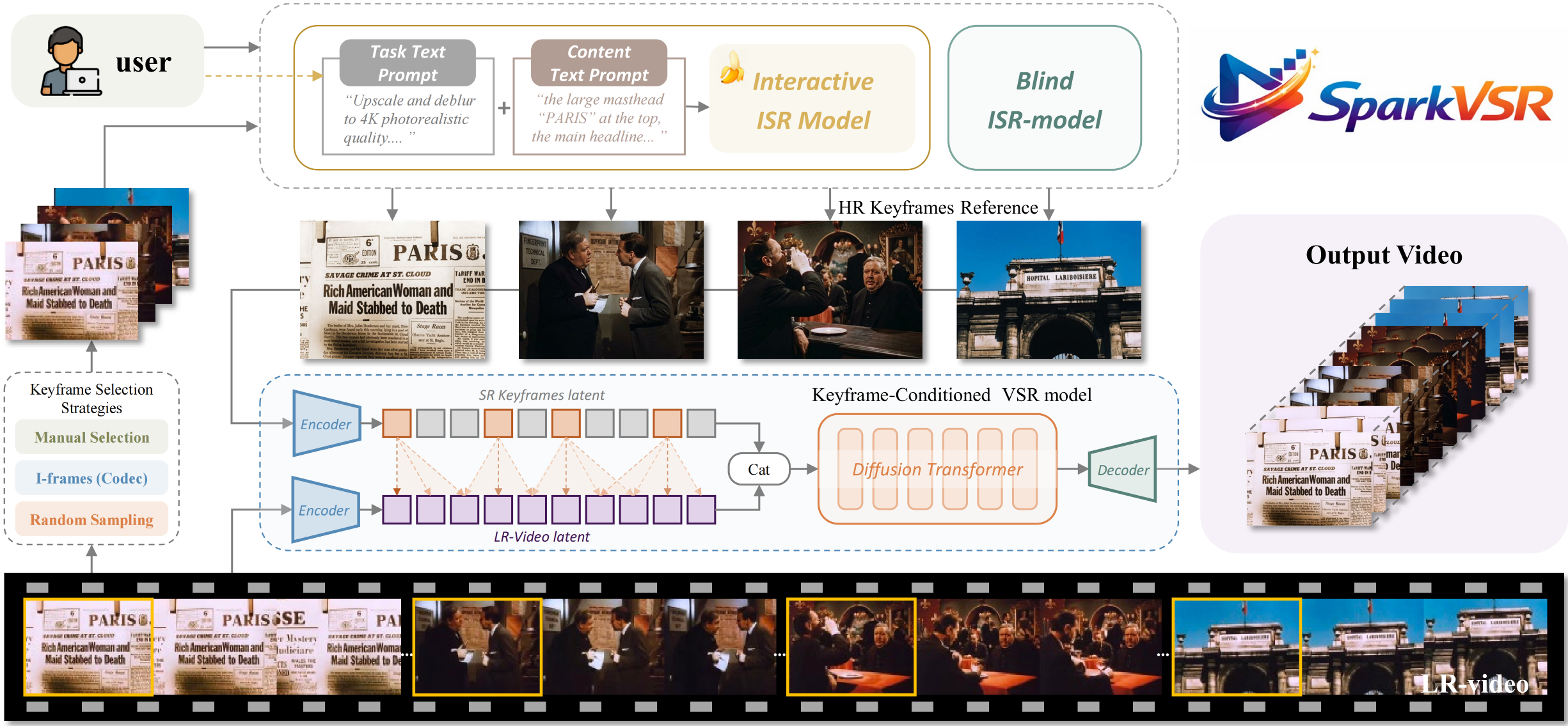
SparkVSR Overall Inference Framework

Overall inference framework of SparkVSR. The pipeline consists of three main stages: (1) Keyframe Selection: LR keyframes are extracted using manual, I-frame, or random sampling strategies; (2) HR Reference Generation: Selected frames are upscaled into HR reference keyframes via an interactive (task/content prompt-guided) or blind ISR model; (3) Conditional Video Reconstruction: A Diffusion Transformer-based VSR model fuses the HR keyframe and LR video latents to guide the generation of the final HR video.

Featured Demo

SparkVSR Video Demonstration

Demo Preview

Abstract

Video Super-Resolution (VSR) aims to restore high-quality video frames from low-resolution (LR) estimates, yet most existing VSR approaches behave like black boxes at inference time: users cannot reliably correct unexpected artifacts, but instead can only accept whatever the model produces. In this paper, we propose a novel interactive VSR framework dubbed SparkVSR that makes sparse keyframes a simple and expressive control signal. Specifically, users can first super-resolve or optionally a small set of keyframes using any off-the-shelf image super-resolution (ISR) model, then SparkVSR propagates the keyframe priors to the entire video sequence while remaining grounded by the original LR video motion. Concretely, we introduce a keyframe-conditioned latent-pixel two-stage training pipeline that fuses LR video latents with sparsely encoded HR keyframe latents to learn robust cross-space propagation and refine perceptual details. At inference time, SparkVSR supports flexible keyframe selection (manual specification, codec I-frame extraction, or random sampling) and a reference-free guidance mechanism that continuously balances keyframe adherence and blind restoration, ensuring robust performance even when reference keyframes are absent or imperfect. Experiments on multiple VSR benchmarks demonstrate improved temporal consistency and strong restoration quality, surpassing baselines by up to 24.6%, 21.8%, and 5.6% on CLIP-IQA, DOVER, and MUSIQ, respectively, enabling controllable, keyframe-driven video super-resolution. Moreover, we demonstrate that SparkVSR is a generic interactive, keyframe-conditioned video processing framework as it can be applied out of the box to unseen tasks such as old-film restoration and video style transfer.

Method

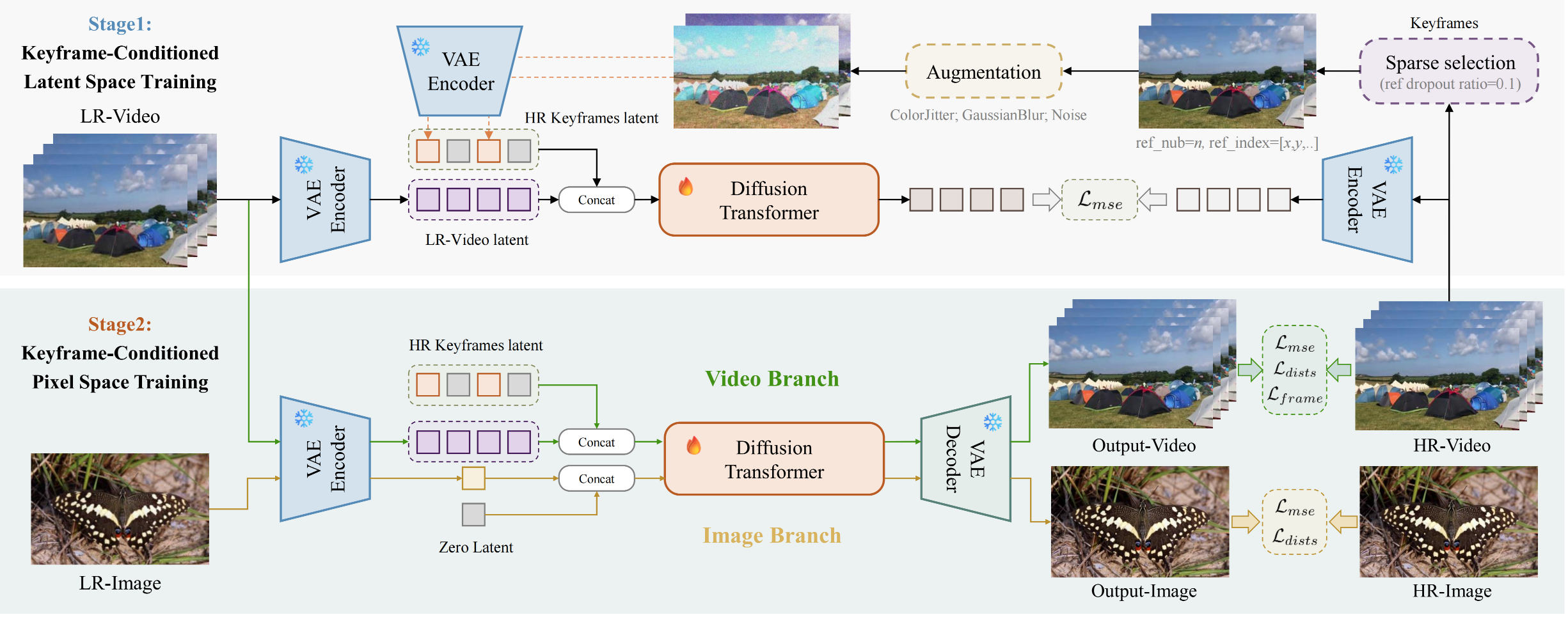
SparkVSR Pipeline

Keyframe-conditioned two-stage training pipeline of SparkVSR. (1) Stage 1 (Latent Space Training): Augmented HR keyframe latents are concatenated with LR video latents to optimize the Diffusion Transformer using $\mathcal{L}_{mse}$. (2) Stage 2 (Pixel Space Training): A joint video-image training mechanism is employed. The video branch is conditioned on HR keyframe latents, while the image branch uses a zero latent. Finally, outputs are decoded by the VAE and refined in the pixel space using mixed losses.

Visual Results

Swipe or use arrows to browse more results in each category

🌿 Natural Scene Video SR

🏙️ Urban Scene Video SR

🎬 Old Movie Restoration

🤖 AIGC Video SR

💡 Drag the slider left/right to compare input and super-resolution result. Use arrows to browse more clips.

View More Comparison Results →

BibTeX

@misc{yu2026sparkvsrinteractivevideosuperresolution,
      title={SparkVSR: Interactive Video Super-Resolution via Sparse Keyframe Propagation}, 
      author={Jiongze Yu and Xiangbo Gao and Pooja Verlani and Akshay Gadde and Yilin Wang and Balu Adsumilli and Zhengzhong Tu},
      year={2026},
      eprint={2603.16864},
      archivePrefix={arXiv},
      primaryClass={cs.CV},
      url={https://arxiv.org/abs/2603.16864}, 
}